
The Trust Stack: A Framework for What Clients Are Actually Buying in an AI World
Why the future of professional services is not about what you can build. It is about who earns the right to build it.
A few months ago I wrote about what happens when AI commoditises expertise. The short version of the piece was that if anyone has access to knowledge through a text prompt, the main thing you're selling is just being accountable. Your willingness to be on the hook when things go wrong.
But I've been thinking a lot about it since I wrote that, and I've noticed a slight hole in the argument. Accountability isn't the major selling point for a client. You don't just turn up to a sales meeting and say "I'll carry the risk" and clients sign... Someone has to trust you enough to let you be on the hook for their outcome, their budget and their deadline.
Trust always mattered in professional services. And that's not changing. What is changing is how much work it has to do by itself.
For most of the last 20 years, competence did a lot of trust's heavy lifting. If the client wasn’t able to build what they needed, they just had to trust whoever could. Client inability created a sort of default trust (structural, not earned).
You had something they needed and that was enough to start.
Now clients that have the time can generate a decent first pass on almost anything. The question stops being "can you do this" and starts being "why would I let you do this instead of doing it myself."
It's a simple question of trust. But most professional services businesses have been leaning on competence-as-trust forever, which still has an impact, but will likely need to change.
The decision making signal that's eroding
For 20 odd years, competence was the primary trust signal in client work. You demonstrated you knew what you were doing, the client believed you could deliver and the relationship kicked off. Your portfolio, extended case studies and credentials are all competence signals.
Agencies’ entire pitch is built around proving competence before the work starts. We did this for them, so we can do that for you.
And it now feels like with AI's capabilities the importance of competence in the decision making process will be less of a factor moving forward.
Think about it. If a client can't tell whether the strategy was yours or Claude's, or whether the code was written or generated, or that the design came from taste or a prompt… competence is no longer a readable trust signal. Don’t get me wrong, competence still matters a lot. I'm not trying to argue it doesn't. It's just no longer legible as a distinctly human quality, which is odd to say, but true.
Clients can no longer base trust on it.
"If my junior analyst can get the same AI-generated insights as my senior strategist, why am I paying for expertise?" — MIT Sloan Management Review
This is a trust question asked from the buyer's side. And the conclusion the article comes to is telling: the value of expensive experts shifts from content to context. Their ability to ask better questions, recognise grey areas and be accountable.
Research from IESE Business School backs this up. After analysing 375 million U.S. job postings between 2010 and 2022, they found that for every 1 percentage point increase in AI adoption at a company, demand for management roles rose 2.5% to 7.5%, with those roles emphasising judgment, collaboration, and interpersonal skills.
Potentially this is more than just "AI is making things cheaper." It erodes one of the key decision making factors professional service relationships were built on.
The Trust Stack
I've spent nearly 20 years in client work, most of it with enterprise clients with relationships that ran years. In those years I’ve noticed that trust builds in four primary layers, in a specific order.
You can't skip any layer and expect the ones above it to hold.
Competence is ground zero. Required. Your work actually does what you said it would. This used to be a primary differentiator.
It's becoming the entry-level ticket everyone holds, because the tools are good enough that baseline competence is easy and accessible. You do still need it. But it no longer earns you anything alone.
Reliability is the frame. You do what you said, when you said. The Thursday update is sent without the client following you up.
The deadline gets met or they hear about it before it passes, not after. A disciplined operator with AI tools can be reliable almost automatically. Still scarce, still human, but partially replicable with good systems.
Honesty now becomes even more important. This is where trust starts concentrating economically. Flagging the budget problem when you first see it, saying "that timeline is unrealistic" when agreeing would be easier.
AIs are typically sycophantic, everything great and doable. So the willingness to push back is a purely human trust signal and it's becoming the most valuable one.
Genuine interest has always been hugely important and more so now. You need to know enough about a client's business to notice things outside your brief. Asking how the campaign performed 3 months after launch because you actually want to know. Those small things add up.
This layer can't be faked. Clients always know the difference immediately.
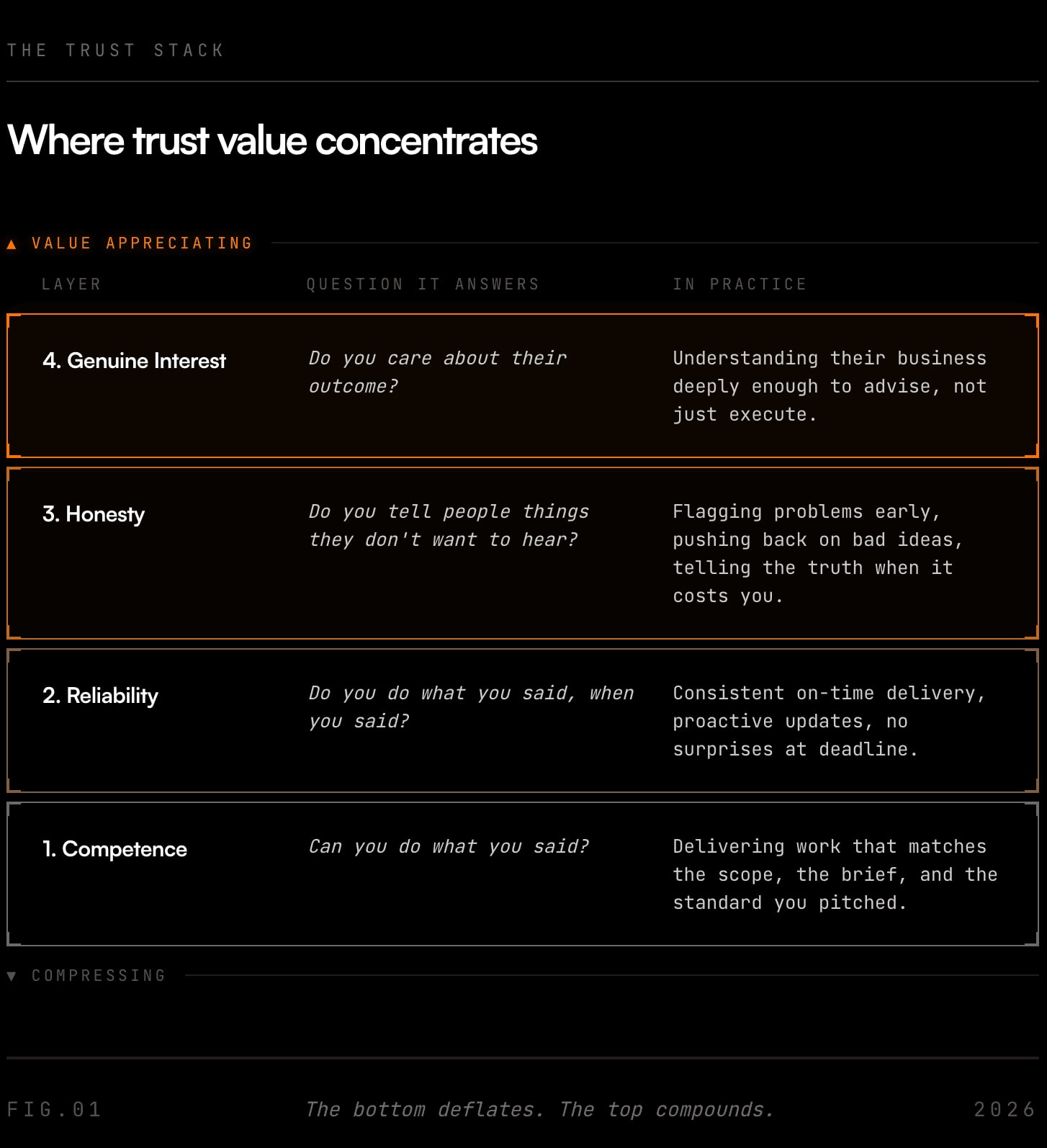
Here’s what this means: layers 1 and 2 are getting compressed by AI, whilst layers 3 and 4 are where value is moving to. Deloitte's 2026 State of AI report found that the right organisations are already changing around this: AI handles execution end-to-end, while humans focus on judgment, exception handling and strategic oversight. The economics of trust are changing. The bottom of the stack is commoditising while the top is appreciating. All still vitally important, but requiring different levels of focus.
Where trust actually forms
Trust doesn't build in the pitch deck or the kickoff meeting. It builds in all of the gaps between formal touchpoints.
I've worked over weekends with teams to ensure a critical release happens on a Monday. I've burnt the midnight oil solving a specific problem for a client because they needed an answer in a meeting the next day. I said I'd do it, so I did it.
The message here isn't "this guy is a workaholic" It's "when he says something, he means it." That hits a little harder than any case study.
I've told enterprise clients their idea wouldn't work, in environments where the stakes were high enough that hedging wasn't an option. Direct, clear, respectful of their expertise in their own business, but honest about mine.
Those conversations were uncomfortable. Most of them deepened the relationship because the client realised I was optimising for their outcome, not trying to bill more.
Some of my best and longest client relationships grew out of genuine interest and curiosity about their business. Understanding what they do at a deep level, what their partnerships required of the brand, what their customers want and expect.
That knowledge only comes from interest in what the client is doing. It's what turned 3-month projects into multi-year relationships.
Every small moment with a client is an opportunity to build trust. A point where you could stay quiet and don't, sugarcoat and don't, clock off and don't. The gaps are where trust gets built and they're the moments AI will never fill because they require judgment about when to act.
What breaks it
Here’s a key piece of advice I’ve learnt in my career. Clients usually forgive mistakes. But they almost never forgive being kept in the dark, that erodes trust.
I've shipped work with bugs, missed deadlines and made recommendations that didn't work. Those situations almost never resulted in a client leaving because I communicated immediately about what happened.
The trust stack was complete enough to absorb a failure at Layer 1 because layers 2, 3, and 4 were intact.
What kills trust is all the small stuff. The reply that takes 3 days or the update that says "in progress" without meaning anything. By themselves, not a problem. But together they accumulate into this felt sense that you're not caring about them anymore. You need to avoid this at all costs.
The client doesn't always know why they decide not to renew. They tell themselves it's price, or they want to try someone new. Often it's the slow decline of a positive feeling they had at the start, which has quietly eroded under many small disappointments.
Data supports this too. This agency churn research finds that clients don't walk because results are bad. They leave because they don't know what's happening, are feeling ignored, or can't connect what you’ve done to their business outcomes.
Bain & Company's research showed that a 5% increase in client retention can boost profits by 25% to 95%. Small trust deposits compound. So do small withdrawals...
If clients don't trust you, they leave. And the ones who stay won't pay premium rates for someone they're not sure about. Client churn looks like a relationship problem but it's a revenue problem. Every small trust failure costs you money.
And the math behind referrals makes this even clearer. Roughly 84% of B2B decision-makers start the buying process with a referral. Be human people! Care about your customers.
Referrals come when clients trust you enough to stake their reputation on recommending you, it’s not easy to achieve. Every small failure of trust doesn't just risk one client. It destroys a pipeline you never see.
Human character isn't promptable
I think the agencies that matter in the next decade won't be the ones with the best tooling or the most advanced AI workflows, those gains will erode fast.
The ones that matter will be the ones clients trust enough to hand them the thing that actually costs something: the risk.
Trust takes years to build and it's earned day after day through small details. An honest conversation. A Sunday night deployment. A small question about their business that nobody asked before that made them think.
I don't know exactly what trust looks like when all of this pans out. I do think the aforementioned layers shift. And I think the layers we focus on need to change. But I think the fundamental mechanism is the same: people trust people who show up, tell the truth and give a damn about the outcome.
And that's a character problem. And character, so far, isn't something you can prompt.