
Everything is More Expensive to Make. And Worse.
How three industries priced themselves out of creativity, and why that's about to flip.
Something weird's happening to the stuff we watch, play, and work in.
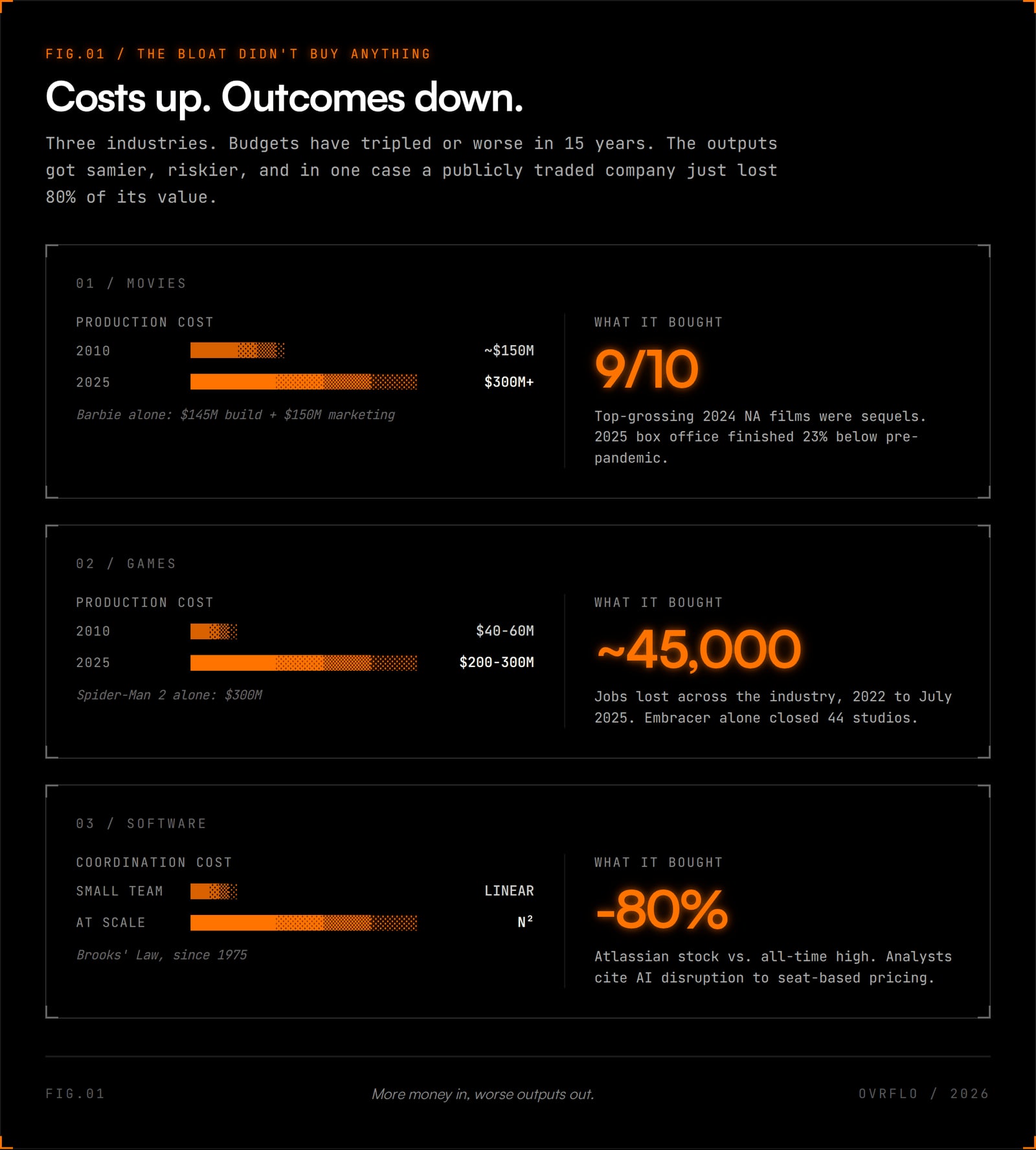
It all costs more than ever. And all of it feels more boring than ever. It seems as if nobody running these industries seems to have a plan beyond "spend more money on safer bets".
I've been thinking about a pattern I'm seeing in movies, games and software. Three massive industries experiencing the same rot.
But recently I've realised everything is about to change for the better.
Sequels all the way down
In 2024, 9 of the top 10 grossing films in North America were sequels. The one exception was Wicked, itself an adaptation of a Broadway adaptation of a book. So, sort of a sequel?
In 2025, 50-70% of films from the 6 major studios were existing IP. The industry has completely stopped making movies. It's just servicing brands now.
And it's also costing a fortune. Modern tentpoles routinely cost $300M before marketing, and Avengers: Endgame spent around $200M just telling people it existed. Barbie's marketing budget was roughly half its $300M all-in cost.
All that spending should buy something. It doesn't. The 2025 domestic box office finished around 23% down on pre-pandemic levels, Avatar: Fire and Ash underperformed, Wicked: For Good underperformed.
Painfully, the mid-budget movie is gone. That $15-90M drama or thriller that used to be the engine of adult cinema went to streaming, because it was cheaper to pad a library than to open on 3,000 screens. So we're spending more, making less, and the interesting middle is disappearing.
Games, same story, different costume
If you'll indulge me, let me draw parallels in gaming. I'm a gamer and view it as an artform.
A blockbuster game in 2010 cost $40-60M to make. Today's AAA titles routinely cost $200-300M. Marvel's Spider-Man 2 cost $300M, and some franchises reportedly break that.
Crysis came out in 2007 and still gets used as a GPU benchmark almost 20 years later. Crysis 2 shipped in 2011 and was the best-looking game of its year. Now pull up footage of a 2025 flagship next to Crysis 2 and I firmly believe the average person wouldn't be able to tell the difference...
Textures are sharper. Shadows are softer. Ray tracing bounces light around in a way the 2011 renderer faked. But the perceptual leap from 2011 to 2025 is nothing like the leap from 1999 to 2011, and we spent 5x the money per title getting here.
It's a full-body diminishing-returns problem. The New York Times reported in late 2024 that major studios are quietly acknowledging graphics investment stopped paying off. Jacob Navok, a former Square Enix exec, put it bluntly: "It's very clear that high-fidelity visuals are only moving the needle for a vocal class of gamers in their 40s and 50s. But what does my 7-year-old son play? Minecraft. Roblox. Fortnite."
So what do we get for all that money? Shawn Layden, former PlayStation boss and the guy who signed off on The Last of Us Part 2, put it plainly in Eurogamer. When a studio plans to spend $160M, he said, the finance guys want a comparable: "Can you show me how the trend line is going to be exactly like Grand Theft Auto?"
The result, Layden says, is "a lot of copycats, a lot of sequels."
Even the game engines are converging. The Witcher 4, Cyberpunk 2, and the Halo remake are all moving to Unreal Engine 5, abandoning their own in-house tech.
Every new AAA release ships with the same hyper-detailed Nanite geometry, the same aggressive bounce lighting, the same soft-shadowed foliage. They look the same, play the same, and feel the same.
Meanwhile the industry is eating itself. Microsoft closed its $68.7B Activision Blizzard acquisition in October 2023, the largest gaming deal in history, and cut about 2,500 gaming staff across two rounds in 2024 across Activision, Xbox, and ZeniMax. Embracer Group, after a $2B investment deal fell through, cut around 4,500 workers, closed 44 studios, and cancelled 80 games across 2023-2024.
The body count keeps climbing. An estimated 45,000 games industry jobs were lost between 2022 and July 2025. Arkane Austin, Firewalk, Ridgeline, Deviation, Volition, Pieces Interactive, Free Radical, Piranha Bytes, all gone.
The budgets went up, the studios went under, and the games got more homogenous on the way.
And big SaaS is flopping too
Software doesn't get released on a Monday and flop by the weekend. It flops slowly, over years, across thousands of dashboards nobody enjoys using.
Atlassian is the cleanest example right now. Peaked at $458 a share in 2021. Still trading in the $300s as recently as February 2025. Now sitting around $67, down 70% from last year's high and roughly 80% off its all-time peak. TD Cowen, KeyBanc, and Truist have all cut price targets in the last month, citing AI disruption to developer platforms and seat-based pricing models.
The interesting bit is the product itself is still growing. Q2 cloud revenue hit $1 billion for the first time, up 26% year on year. The business is fine. The market just stopped believing Jira and Confluence deserve a premium multiple, because the thing they were selling was the coordination tax itself. Tickets, workflows, approval chains, seat licences billed per knowledge worker sitting in the meeting.
Brooks' Law has been sitting there since 1975 telling anyone who'd listen: coordination cost scales with the square of team size. Add 10 engineers, you don't get 10x the velocity. You get a slower team and more meetings. Atlassian turned that maths problem into a subscription business, and for 20 years it looked like genius.
AI collapses the premise. A person with Claude and a code agent doesn't need a pod of 8 engineers, a Jira board, and a quarterly planning cycle. They need a laptop. The moment that becomes normal, a product category built on coordinating large teams is selling aspirin to people who just stopped getting headaches.
And the same flattening is hitting everything else in the category. CRMs, project management tools, HR platforms, analytics suites. Same sidebar nav, same data tables with zebra striping, same command-K modal, same friendly-illustration empty state. The dominant aesthetic is "Linear, but for [category]." Design systems optimised for consistency have sanded the personality right off the product.
People used these tools because they had to. Not because they enjoyed them. That's a precarious place to sell software from when the alternative is "just ask the AI to do it."
Why all three rhyme
Production is now so expensive that risk tolerance has died, and now that it has, the only thing that gets made is something that already looked like something that worked.
You can't greenlight Everything Everywhere All at Once if the comparable is Avengers. You can't ship Balatro if the comparable is Call of Duty. You can't build Figma if the comparable is Salesforce.
None of the inefficiency was ever necessary. It was the price of coordinating too many people around a bet too big to fail.
Now the reset, in the same order
Let's walk it back through. Movies first.
Go watch The Dor Brothers' stuff. They're a Berlin-based AI studio running a tiny core team plus freelancers, and they made an official AI music video for Snoop Dogg in 2024, an ad campaign for Hugo Boss, and a Trump/Putin satire video that hit 100 million views the day after the election.
The studio's AI videos pulled half a billion views last year.
It's worth mentioning that the models obviously aren't there yet. The output still looks like AI. People mock it for that, and the mockery is fair enough for now.
But watch the trajectory. Their 2025 short Apex, made with Seedance 2.0, is a different class of thing entirely to the Snoop video from a year earlier. Character coherence, action staging, cinematographic transitions, all noticeably closer to the AAA baseline.
Runway's Gen-4 and Sora 2 have solved the character consistency problem that killed AI video for narrative work, and Runway raised $308M in 2025. The weirdness in what we're watching now is a 2026 problem, and 2026 is not going to last long.
Now games.
Balatro, a poker roguelike by a pseudonymous solo dev called LocalThunk, sold over 5 million copies. He expected to sell maybe 10 and go back to his IT job.
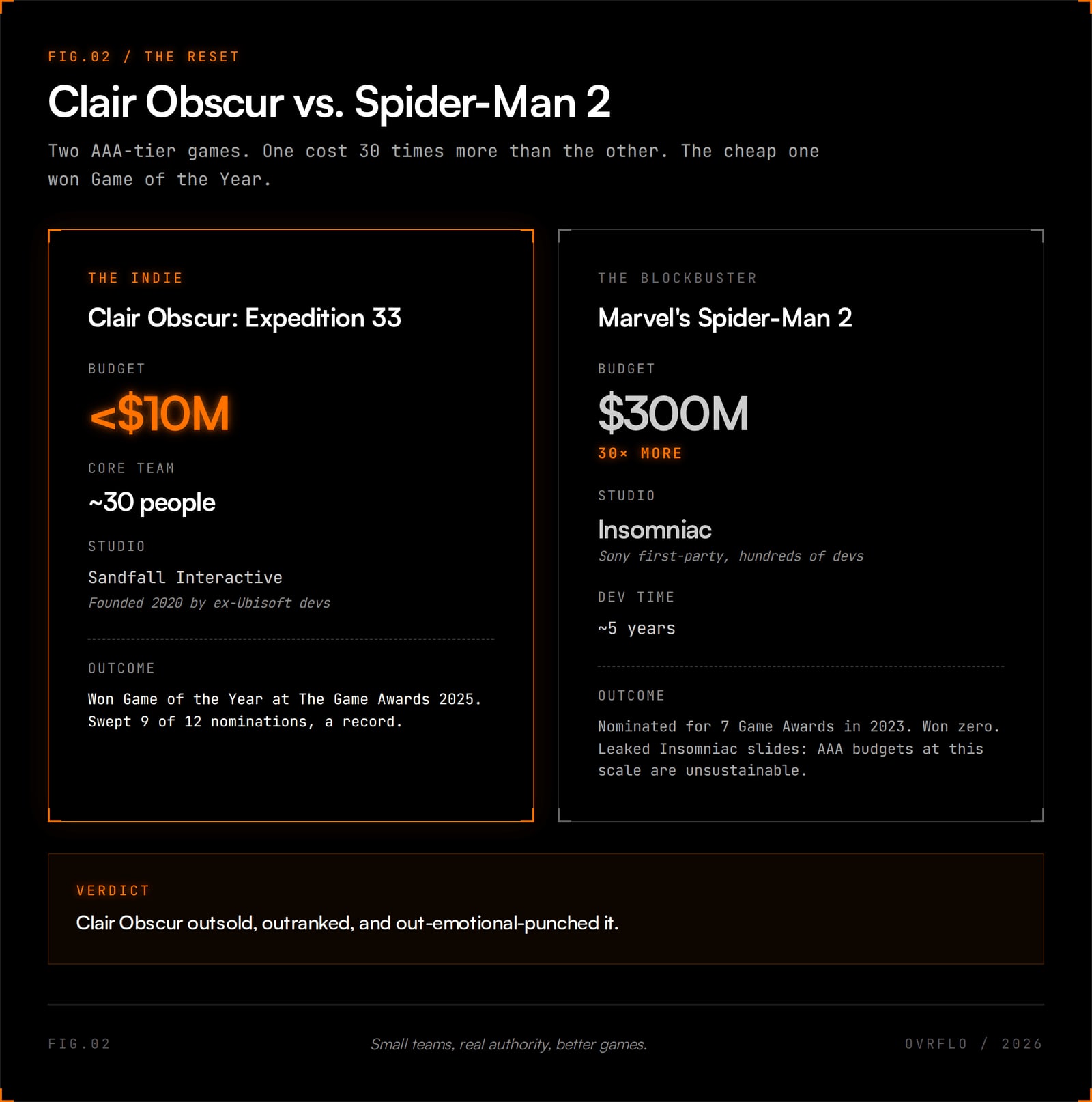
Clair Obscur: Expedition 33, the most nominated game in The Game Awards history and 2025's critical darling, was made by Sandfall Interactive, a team of about 30 people, for less than $10 million. Marvel's Spider-Man 2 cost 30x that. Clair Obscur outsold, outranked, and out-emotional-punched it.
Now software.
In late 2024, after a long stint on Israeli military reserve duty, Maor Shlomo started building Base44, an AI-native app builder, as a solo side project. Roughly 6 months later Wix acquired it for $80M cash. At acquisition Base44 had 250,000 users, generated $189K profit in May 2025, and Shlomo was the sole shareholder.
Midjourney generated roughly $500M in revenue in 2025 with about 107 employees, ~$4.7M per employee. A typical enterprise SaaS runs an order of magnitude below that.
The share of new US startups with a solo founder jumped from 23.7% in 2019 to 36.3% in H1 2025.
Something structural has changed.
Where the money was really going
Back to that coordination tax I flagged in the software section. It's why things are the way they are. The cost of coordination at scale and production is destroying creativity. But the good news is, AI is changing it.
Most of the cost in a $300M game was the org chart, not the art. Most of the cost in a $150M film was the machine for delivering the story through studios, agents, VFX houses, union schedules, and 8 layers of approval. Most of the cost in a bloated SaaS platform was the 5-team chain shipping each feature.
When that overhead drops, the thing that floats back to the surface is taste. The solopreneur, the tiny film team, the individual game dev, they make better things because a single coherent vision survives to the final cut without being focus-grouped into mush.
Balatro, Clair Obscur, Base44. Three projects, three very different paths, same underlying pattern. A small group of people with real creative authority, nobody above them forcing the vision to look like the last thing that worked.
Clair Obscur is worth pausing on because it's the pre-AI version of the pattern. Let me take you on a sidequest for a little bit.
Guillaume Broche left Ubisoft in 2020 because he was bored, recruited friends and contacts he trusted, and spent the next 5 years building this incredible experience.
He's on record saying a project like that would've taken 25 years to make in a big company because of approval steps and bureaucracy. Ubisoft had the tools and the talent. The coordination layer would've ground the vision into paste.
The weirdness in this game (turn-based combat in 2025, Belle Époque aesthetic, paintbrush-named characters) is a symptom. What we're actually seeing is creative trust left unsanded. Same story with Balatro's poker-roguelike obsession and Base44's chat-to-app premise.
What AI changes is the economics of running the pattern. Broche needed 5 years, a move away from a stable job, and the kind of personal stamina most people don't have. Brutal cost for a creative bet, even when the bet lands.
The new economics shift that. A comparable vision in 2026 could ship in 18 months with 4 people and a stack of AI tools, because the surrounding machinery is cheaper. Fewer contractors, less outsourcing, less time spent on the parts of production that aren't the creative vision itself.
We're going to see more Clair Obscurs.
The part I'm less sure about
Some of this is already wobbling.
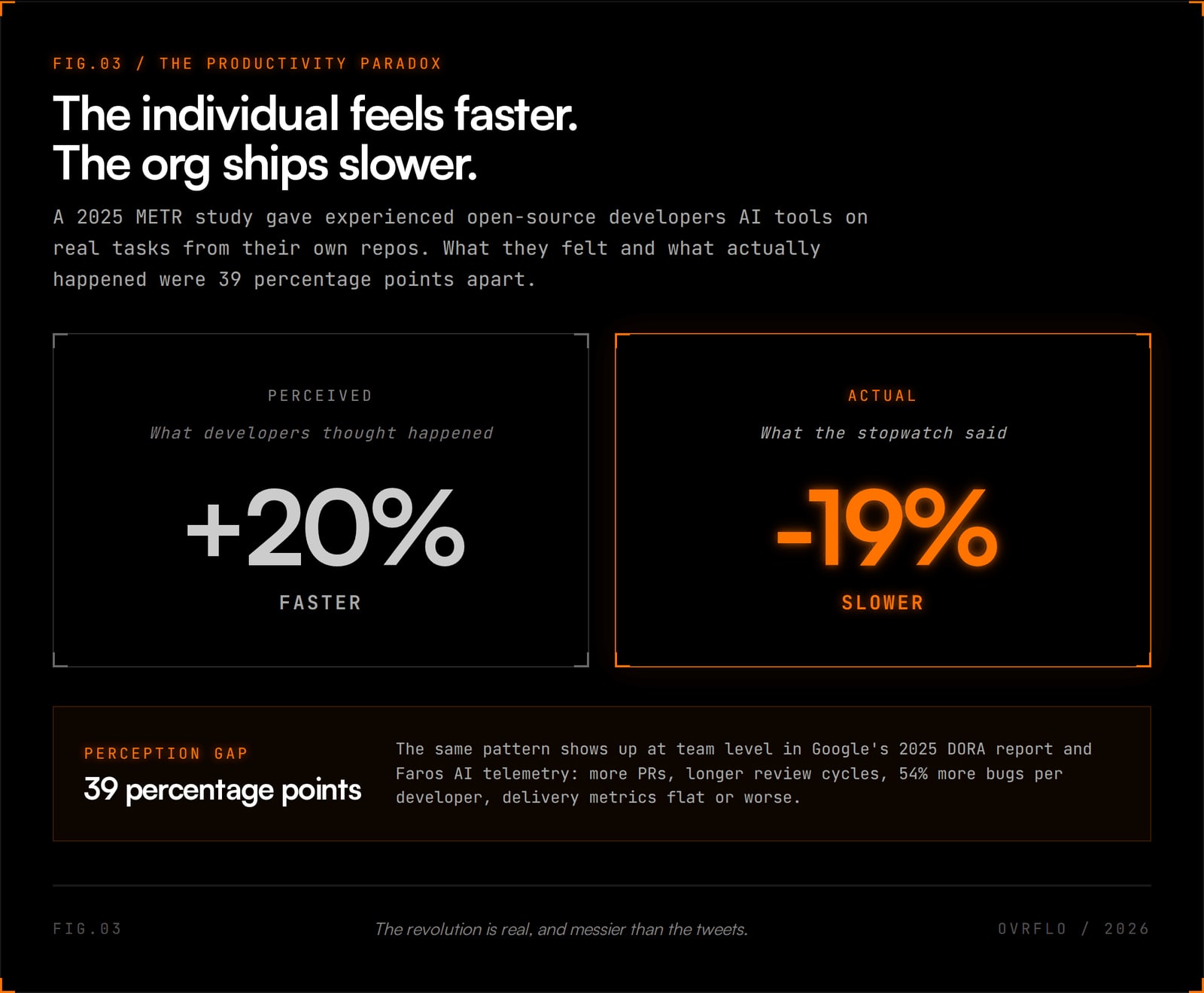
Take AI coding. A 2025 METR study gave experienced open-source developers AI tools and timed them on real tasks from their own repos. Developers thought they'd gone 20% faster. They'd actually gone 19% slower. Google's 2025 DORA report and telemetry from Faros AI find the same thing at team level: more PRs, longer review cycles, 54% more bugs, delivery metrics flat or worse. The individual feels faster. The org ships slower.
"Solo unicorn" is also mostly marketing. Base44 had 6 employees by the time Wix bought it, all hired in the month before acquisition. Clair Obscur wasn't really 30 people either, it was 30 Sandfall staff plus outsourced battle animations, external marketing, external localisation, and publisher Kepler's money.
The lone genius makes good headlines and bad history. The revolution is real and messier than the tweets.
There's also a cultural barrier with AI adoption, and gamers are leading the charge here. Clair Obscur was stripped of both Game of the Year and Best Debut at the 2025 Indie Game Awards after a 2022 interview resurfaced where Sandfall admitted they'd experimented with AI.
The AI-generated assets in question were placeholder textures, patched out within 5 days of release. The awards came back off the shelf regardless.
Broche himself went on record after the backlash to say the studio wouldn't use AI in future projects at all. "Everything is human-made" was his exact line. You can hear the defensiveness in it, a small studio trying to keep its audience on side in a cultural moment where any AI use is treated as a betrayal.
I think gamers need to sit with this one. If you want more Clair Obscurs, developers need production methods that make Clair Obscurs economically possible. Refusing them every tool that might shorten the timeline is asking artists to keep suffering for your entertainment.
There's a real distinction between AI stealing from artists (generating textures, art, voices trained on uncredited work) and AI removing production overhead (scheduling, localisation pipelines, code scaffolding, placeholder assets during prototyping). Treating them as the same thing hands the creative win back to the big studios, because only the big studios can absorb the cost of doing everything the hard way. The small teams this article celebrates are the ones the backlash actually punishes.
Think about the odds for a second. Broche happened to get bored, happened to find the right people, happened to have the personal runway to work 5 years on passion and delayed pay, and happened to ship a game that resonated hard enough to sell millions.
Any one of those links failing and Clair Obscur never exists. The chances of the whole chain holding together were infinitesimally small. We got lucky.
Counting on miracles is a bad industry strategy. AI is the thing that makes miracle-tier projects slightly less improbable, and gamers booing it off stage is asking the entire indie scene to keep rolling natural 20s on D&D dice.
There's also a bigger point underneath all this. You cannot beat technology. It moves forward whether you like it or not, and the people who use it will outpace the people who refuse.
Sampling was the enemy once. Splice loops were the enemy once. Auto-Tune, Pro Tools, digital cameras, CGI, spellcheck, calculators, electric guitars. Every one of them got the same backlash, and every one of them is now part of how professionals work.
AI is the current version of that argument. The gamers currently demanding that every studio pledge "everything is human-made" are writing the 2026 equivalent of the "real music is only made on tape" letter to the editor.
The studios that use AI thoughtfully will ship more, take bigger creative risks, and survive. The ones that don't will get consolidated, shut down, or spend another 5 years on passion and delayed pay to prove a point nobody was asking them to prove.
What I think is coming
The bloat served nobody. Not the audiences, not the players, not the users staring at another Linear in a different colour.
AI didn't invent creativity. Creativity was already there, buried under 40 people in a Slack channel arguing about the roadmap.
What AI does is drop the price of shipping a coherent vision to where one person, or one small team, can get the thing out without it being sanded flat by committee. What we're laughing at today is the rough first draft of something a single director with a strong vision will make from their spare room, and it won't look like a joke for long.
We're about to see a renaissance. Not because AI is magic, and not because anyone in power wanted it.
The gatekeepers are still there, still holding the cheques, still demanding comparables. They're just about to find out that the cheques don't matter as much as they used to.
A kid in a bedroom with Claude and Runway can now ship things that used to require a studio, a publisher, and 3 years of approval cycles. Some of what that kid makes will be terrible. Some of it will be better than anything on the Netflix front page.