

The More AI Does, the More Good Design Is Worth
AI has made production cheaper. It has not made judgement cheaper.
Everyone now assumes AI drives creative costs down.
For commodity work, it definitely does. A basic landing page that cost $3,000 about 18 months ago can now be generated in an afternoon for close to nothing, I've done it. Social media templates, standard icon sets, generic brand guidelines. It's all a few prompts away.
Production costs for this tier of work are approaching near zero and they're not coming back.
But for everything above commodity, AI is making design more expensive. Sounds counter-intuitive but I have a hunch and the data now backs it up.
When "Good Enough" Looks Professional
When AI-generated design was rough, the value of a human designer was obvious. You could see the difference. The layouts were awkward, the typography was wrong, the spacing felt off.
That's becoming harder to see and will eventually be over.
AI output is starting to cross the "good enough" threshold for most business applications (not all). It handles layout competently, applies colour theory correctly, follows accessibility guidelines.
Which means the difference between AI-generated design and genuinely effective design is becoming invisible to most buyers. And the invisible differences are where pricing gets interesting.
The Envato State of AI in Creative Work report found that 30% of creative professionals pointed to graphic designers and illustrators as the role AI will transform most. Disciplines built on craft and signature style face real questions about value when AI makes "technically competent" accessible to everyone.
Designers aren't resisting the tools. They're trying to navigate a market where customers conflate speed with value.
The Sewing Machine Problem
In 1851, Isaac Singer's sewing machine split tailoring in half. Mass-produced clothing became cheap and accessible. Bespoke tailoring became more expensive than ever, because the comparison point changed.
When everyone could access "good enough" clothing, the premium for craftsmanship wasn't competing against nothing anymore. It was competing against factory output. The two looked closer than ever, but the distance in value had never been wider.
It's clear to me we're watching the same thing happen in design.
AI handles the production layer: executing known patterns competently. What it can't handle is the judgment layer. Knowing which pattern to break, when the brief is wrong, where the user's stated need diverges from their actual behaviour.
That judgment layer used to be bundled into the production cost. You hired a designer, you got both. Now that AI unbundles production from judgment, the judgment stands alone.
Turns out judgment is the expensive part. It always was (it was just hidden in hourly rates).
The Numbers
The data on this split is starting to pile up.
Vollna's 2025 analysis of 2.2 million Upwork projects found that the overall market dropped 9% year-over-year, with writing projects taking the steepest decline. Entry-level project availability collapsed from 15% to below 9%. Commodity creative gigs (think $40 blog posts and product descriptions) have been effectively replaced by AI tools.
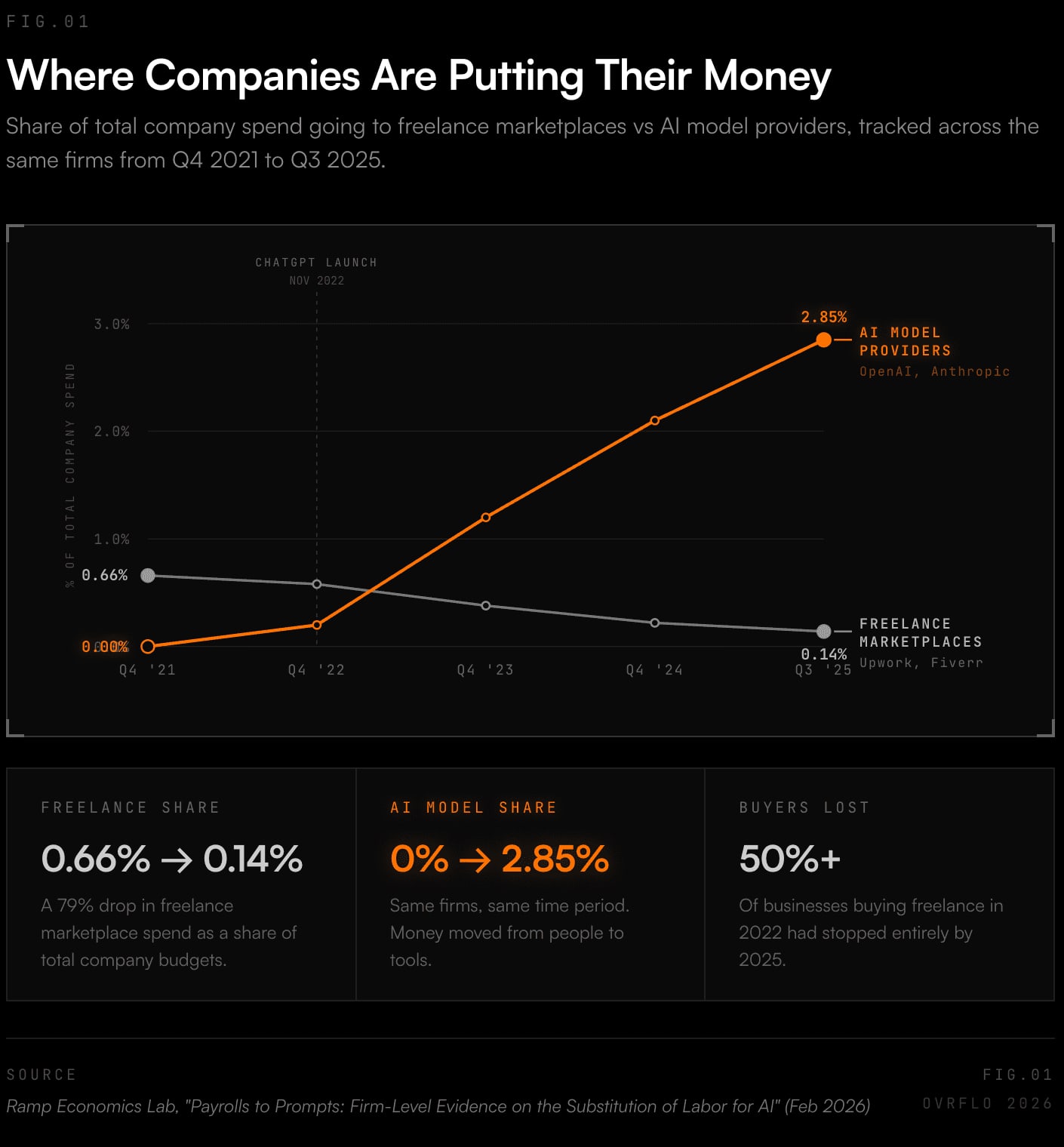
The Ramp "Payrolls to Prompts" study painted an even starker picture: more than half of businesses that were spending on freelance platforms in 2022 had stopped entirely by 2025. Freelance marketplace spending as a share of total company spend fell from 0.66% to 0.14%. AI model spending went from zero to 2.85%.
But look at the other side. Upwork's 2024 annual results showed that freelancers working on AI-related projects earned 44% more per hour than those on non-AI projects. AI-related work on the platform grew 60% year-over-year.
Fiverr's 2024 data told a similar story from the buyer side: average spend per buyer climbed while total active buyers declined. The projects that remain are harder and more valuable, and clients are paying accordingly.
The Freelancer Kompass 2026 report found that 84% of freelancers now regularly use AI-powered tools, up from 41% in 2023. They're not being displaced. They're becoming more productive, and the ones who combine AI fluency with strategic thinking are pulling away from everyone else.
The market isn't lowering prices uniformly. It's bifurcating. Production races toward zero. Strategy races toward a new premium.
Why Studios Get This Wrong
One method studios are using to respond to AI is by cutting prices to stay competitive with AI-assisted freelancers. The logic seems sound: if a solo designer with Midjourney and Cursor can produce a landing page in 4 hours, a studio charging $15,000 for the same deliverable looks absurd.
But it's the wrong comparison.
The studio is selling the research that determines what the landing page should say, the strategic framework that connects it to the broader customer journey, and the accountability when it doesn't convert. A freelancer with AI tools can match the output. They probably can't match the entire context and experience piece there.
Studios that lower prices to compete on output are commoditising themselves. They're voluntarily entering a race they can't win, because AI will always be cheaper at production than any human, regardless of how many AI tools that human uses.
How to Price for Judgment
If judgment is the product, you can't price by the hour. Hours measure effort, and AI just made effort cheap. Time and materials is dead. Put a fork in it.
Pricing by the hour in an AI world is like pricing electricity by how hard someone pedals the generator.
The alternative is pricing by the decision. What's it worth to know your checkout flow is optimised for mobile-first purchasing behaviour in your specific demographic? What's it worth to catch that your brand positioning inadvertently mirrors a competitor's failed rebrand?
These are judgment calls. And they're worth more now than they were 2 years ago, because the cost of getting them wrong is higher.
When production was expensive, a bad strategic decision wasted $50,000 in development time. When production is nearly free, a bad strategic decision wastes an entire market window, because your competitor with better judgment ships their version just as fast.
What This Means If You're Buying Design
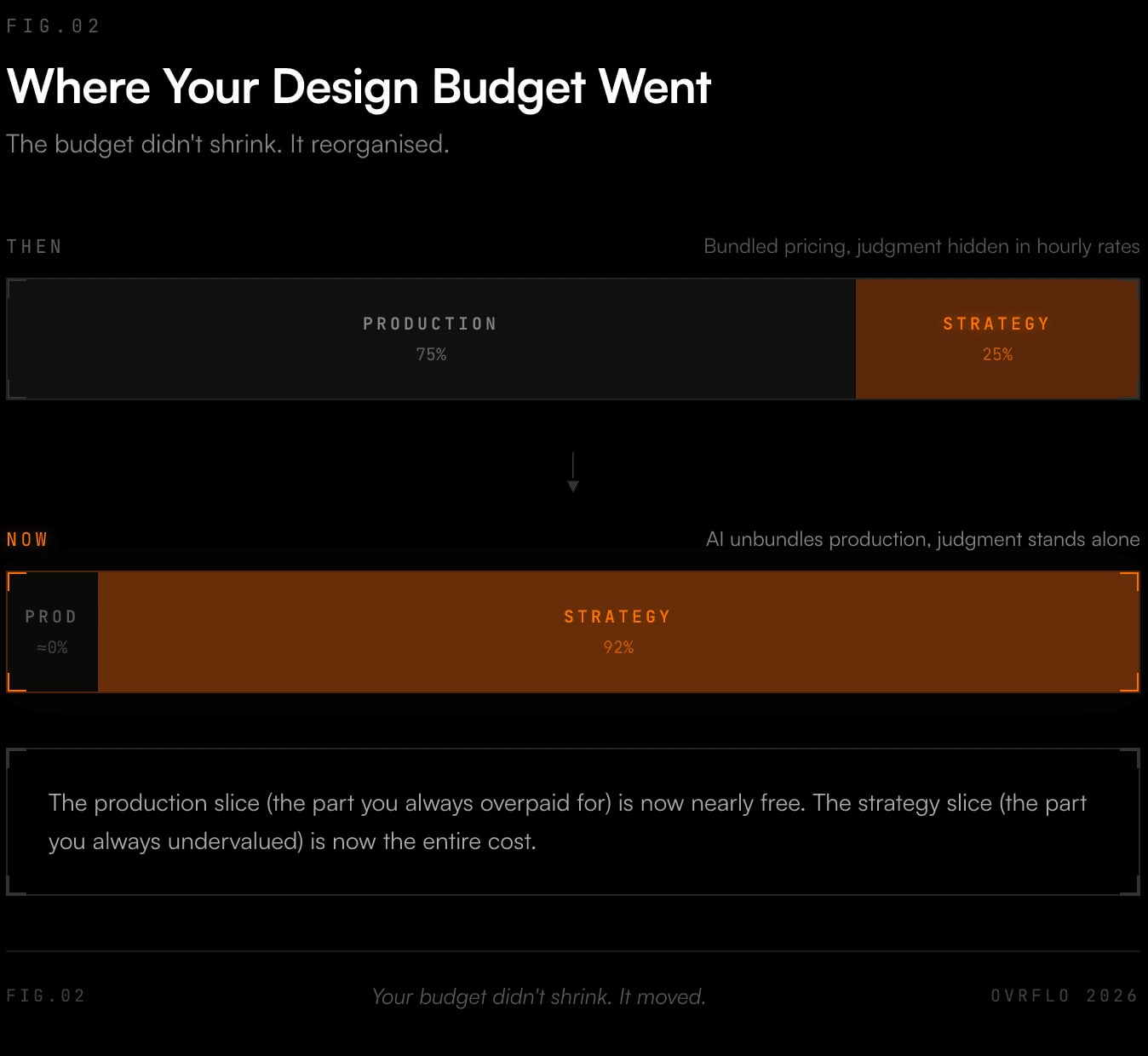
If you're a business hiring design services, AI didn't make your design budget smaller. It reorganised it.
The production slice (the part you always overpaid for) is now nearly free. The strategy slice (the part you always undervalued) is now the entire cost.
Smart buyers will reallocate. They'll use AI tools for production and invest the savings into better strategic partners. They'll stop asking "how much does this website cost?" and start asking "how much does it cost to know this website is the right website?"
Most buyers won't do this. They'll chase the cheapest AI-generated option, launch mediocre work fast, and wonder why it doesn't convert. Then they'll hire a strategist to fix it, and pay more than if they'd started there.
The opportunity here with a flood of AI-generated sameness is that standing out in it is a thinking problem.
The businesses that invest in genuine strategic design will probably look like they're from a different planet compared to the ones running on auto-generated templates. I think the distance between those two only grows from here.
What This Means If You're a Designer (Especially a Junior)
The designers who'll thrive in this are the ones who are hungry to understand why design works, not just how to produce it.
Fundamentals matter more now than they did 5 years ago. Typography, hierarchy, information architecture, user psychology, the stuff that others can't prompt their way through. AI can execute a layout, but it can't tell you that the layout is solving the wrong problem.
The best use of these tools is to strip away the production hours and spend that time on the thinking. Research. Testing. Sitting with a problem long enough to find the non-obvious solution. That's where the premium lives now. Ironically, slowing things down, but in the right areas.
If you're early in your career, this is probably the most important thing to hear: learn the fundamentals harder than you've ever learned anything. Get obsessive about what makes great work great. Then use AI to multiply that understanding into output that would've taken 3 people 2 years ago.
The tools make good designers faster. They don't make mediocre designers good.
Where This Leaves Us
Production work is AI-priced now. Approaching zero.
Strategic work is premium-priced and rising. The fewer people who can do genuine strategic design thinking, the more it's worth. Upwork's own data shows the ceiling climbing even as the floor collapses.
The messy middle is the hardest place to be. Too expensive to win on price, too executional to justify premium rates. Most freelancers and mid-tier agencies sit here today and AI didn't create the squeeze so much as it ripped the band-aid off.
So what happens to the junior designers who would've previously grown into that strategic layer by learning judgement from 3 years of production work? If AI eats the apprenticeship rung, where does the next generation of senior designers come from?
Maybe they compress 3 years of production reps into 6 months of AI-assisted iteration and spend the rest learning to think. Maybe fewer of them make it through. But maybe they're worth more.