

Taste Can't Be Prompted. That's Why Designers Matter More Now.
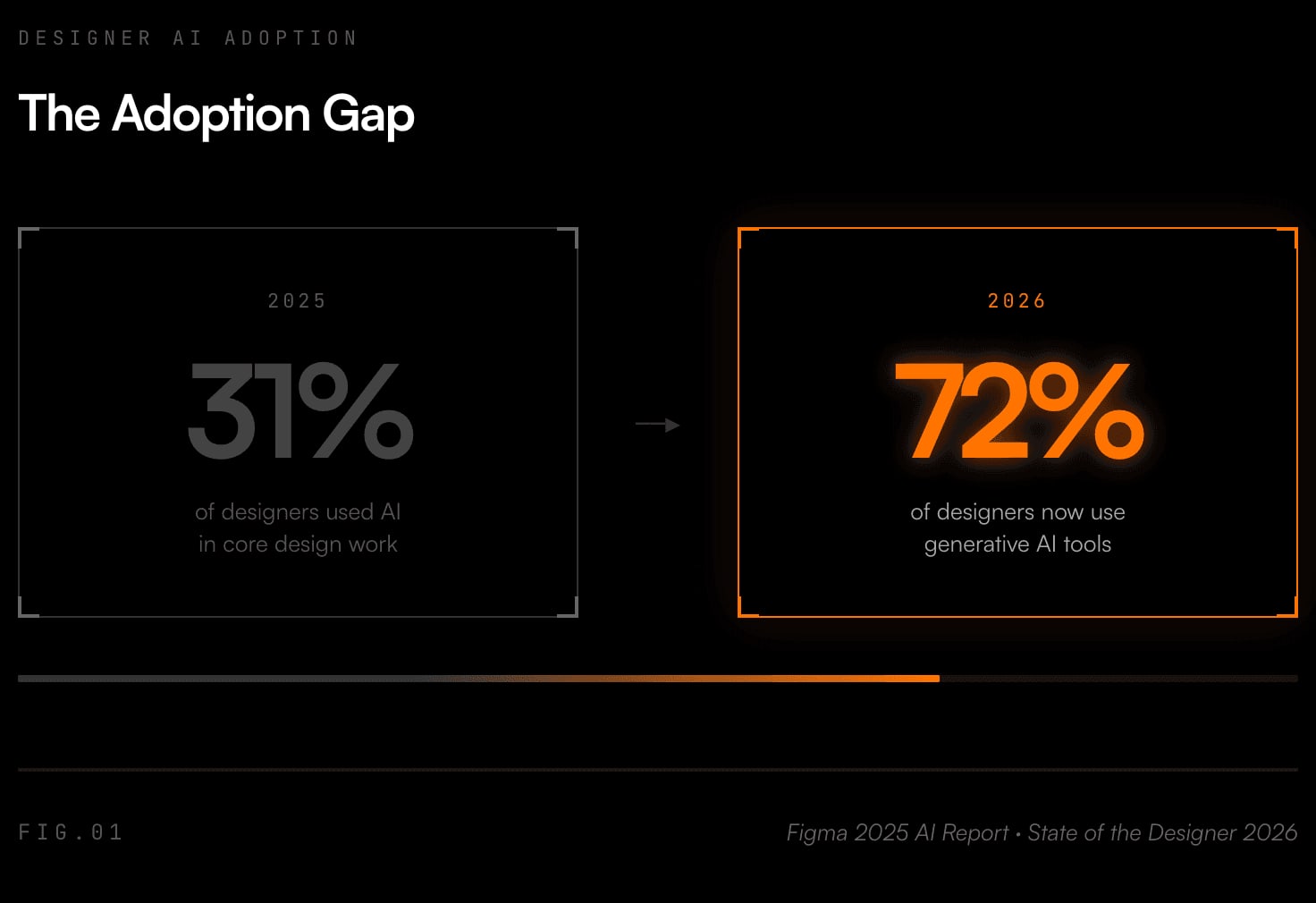
Designers went from 31% AI adoption to 72% in a year. The ones thriving are not the ones with the best prompts.
Almost a year ago Figma surveyed 2,500 designers and developers on AI adoption.
31% of designers used AI in their core design work. 59% of developers used AI in their core development work.
A 28-point gap that was in favour of the profession that was supposedly less threatened by AI.
Think about what design has faced in the last 2 years. Image generation. Layout automation. Vibe-coding prototype builders. Figma Make turns a prompt into a working interface. If any profession had an urgent reason to get comfortable with these tools, it's designers.
And yet designers were the ones holding back.
I say "were" because in the past year the data has shifted. Figma's State of the Designer 2026 report (906 designers, published February 2026) tells a different story: 72% of designers now use generative AI tools. Of those, nearly all (98%) increased their usage in the past year. And of that group, 91% say AI helps them create better designs, 89% say it helps them work faster, and 80% say it improves collaboration.
That's a huge swing. But the increase in usage isn’t really what I’m interested in.
Design Has An Identity Problem
I've seen this in the design space: designers holding on to the current workflows as the right way to do something and that using AI in certain areas is cheating or feels dirty.
I get it. There's a real concern with AI systems plagiarising the artwork of designers for use within their models. I understand that, but AI is a brush; it's another tool designers can use to craft the outcomes that they want. Designers were always able to reference other designers' materials, tweak and change to make it feel their own. This is the same just at an accelerated rate.
A lot of designers entered the profession because they wanted to make things with craft and care. The pixel-perfect layout. The organic animations eased to perfection. Using AI to do that work feels like outsourcing the part that made you want to do it in the first place. But in reality it's just a natural transition of the tools we use.
Figma's 2026 survey asked designers how they feel about the profession. 36% said design had gotten better. 35% said worse. 29% said no change. A near-perfect 3-way split. The vast majority (89%) gave tempered responses too, choosing "better," "worse," or "about the same" rather than anything extreme.
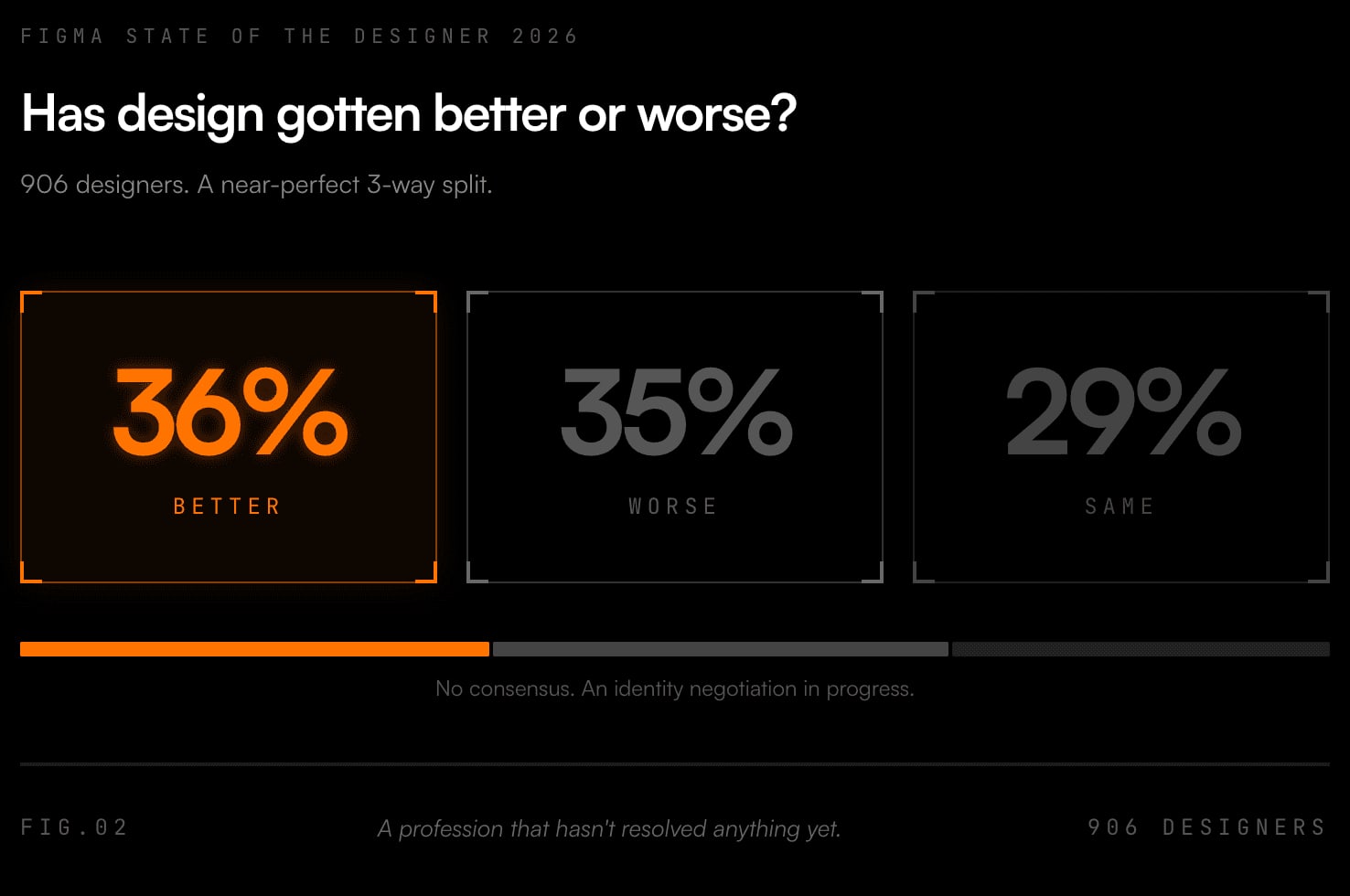
It feels like we’re a profession in mid-negotiation. We’re in limbo.
Most organisations aren't engaging with that nuance. They're just buying tool licences and expecting designers to love it and deliver quality faster. But that's not how our identity works.
Is It Any Good?
Figma's 2025 AI report found that 78% of designers and developers agree AI enhances efficiency. Ask designers specifically about quality and the picture changes. Only 54% of designers said AI improves the quality of their work, compared to 68% of developers.
To me that was the most unsurprising part of the report.
Developers to a degree tolerate imperfect AI output because their workflow is built around iteration: write, test, refactor, ship. A code suggestion that's 80% right is still useful. You fix the other 20% and move on.
A layout that's 80% right is wrong. A brand identity that's mostly on-target but slightly off-tone makes the whole thing useless. Designers have spent careers developing taste, the ability to know when something is "technically fine" but not "actually good." AI delivers the former. But rarely the latter. I know, as I've tested pretty much every design AI tool there is. None nail it out of the box.
It was good to see the 2026 numbers more encouraging. Of designers who increased AI usage, 91% say it helps them create better designs. But a UserTesting study from early 2026 complicates that: 91% of designers say they work faster in AI-enabled environments, yet only 15% feel "much more confident" in quality. Confidence peaks during early exploration and drops as the iterative loop of design improvements starts.
The researchers were direct:
Don't get me wrong, designers adopting AI are reporting genuinely better work. But "better" and "I'd stake my reputation on it" are two different things. That gap is taste. And it's so clear to me that AI doesn't have it, and may never have it.
Are We Replacing The Bridge?
Developers got GitHub Copilot. Invisible. Assistive. Bolted directly into the existing workflow. You type code, it suggests the next line. You accept or reject with a keystroke. 20 million developers use it. It generates 46% of code in projects where it's active. 90% of Fortune 100 companies adopted it.
That adoption happened because Copilot didn't ask developers to change how they work. It just made the existing process faster.
Designers… got something else.
Figma Make generates entire apps from a prompt. Midjourney produces incredible images. Framer Workshop builds complex components. Google Stitch lets you describe a business objective and get an interface. These are replacement tools that bypass a workflow, they're not assistive tools that sit inside one.
When a tool slots into your flow, you get to maintain your agency. You're still the designer. When a tool replaces that flow altogether, you become the reviewer, quality-checking someone else's first draft. That's a fundamentally different relationship with your work. Some might lean into it; some might hate it.
The bridge tools (the ones that let designers weave AI into their existing process rather than surrender it) are starting to appear. Figma's Config 2025 launched Draw and Buzz. Schema 2025 pushed further with Code Connect and design system features. Figma acquired Weavy and relaunched it as Figma Weave, a node-based workflow canvas for chaining AI models with professional editing tools. But the more interesting movement is happening outside Figma.
Pencil hit 100,000 users in 5 months with AI agents that design alongside you on a shared canvas. Paper lets Claude Code and Cursor write directly to a design surface. MagicPath converts any live URL into an editable design you can riff on. And Flora just shipped FAUNA, a creative agent that learns from your existing work and taste before generating anything (Pentagram and Netflix are already using it in production).
These feel closer to the Copilot model. Assistive. Inside the workflow. Designers maintaining agency while AI handles the parts that used to eat the clock.
Interestingly designers at startups are adopting AI roughly twice as fast as those at large companies. I think that's because they have less process to adhere to and need to move fast.
I Believe Craft Is the Differentiator
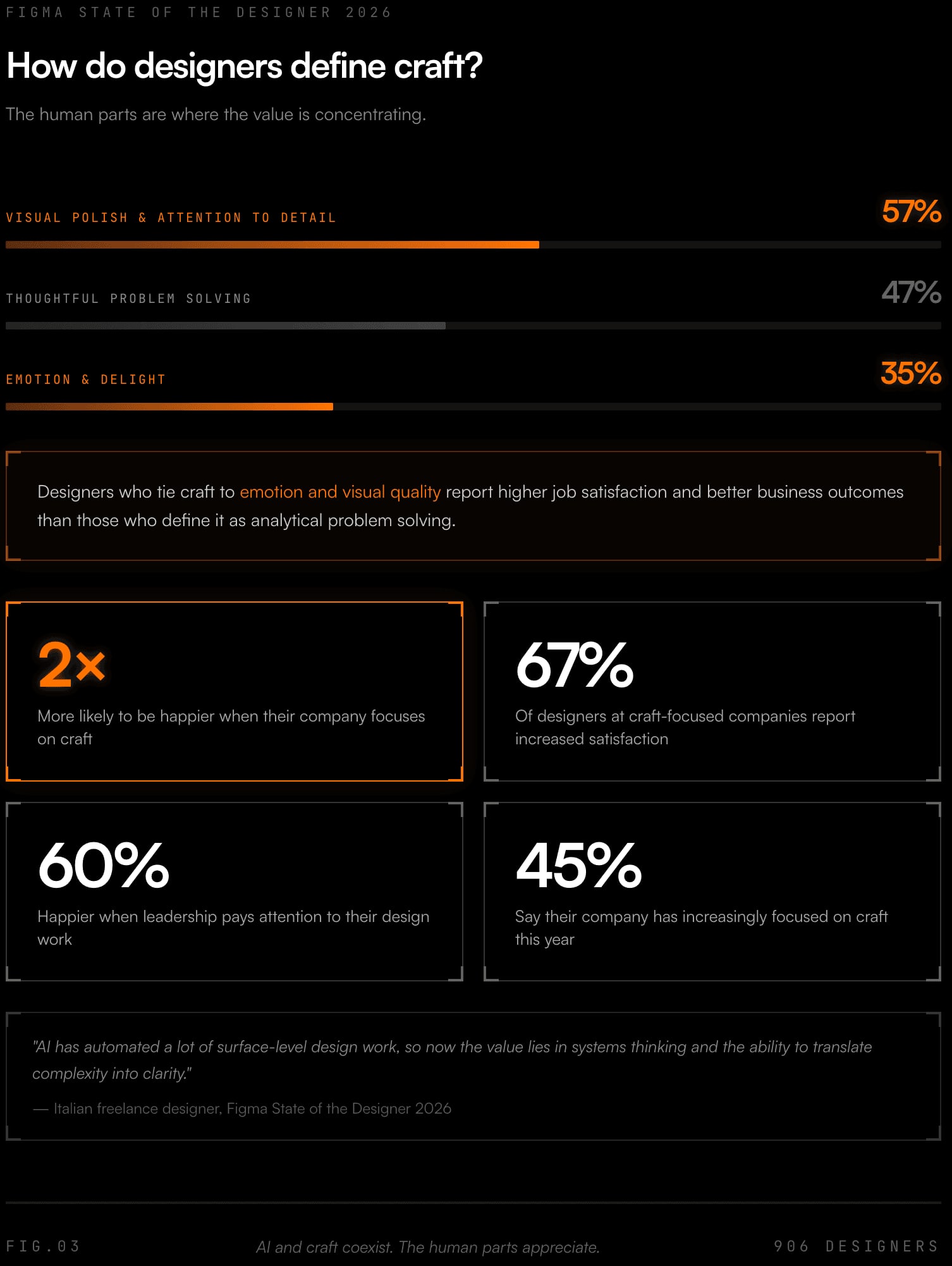
Figma asked designers to define craft. 57% said visual polish and attention to detail. 47% said thoughtful problem solving. 35% said emotion and delight.
The designers who tie craft to emotion and visible quality report higher job satisfaction and better business outcomes than those who define it as analytical problem solving. The parts of design that are hardest for AI to replicate are the same parts that make designers happiest and most successful. Shock horror.
45% of designers say their company has increasingly focused on craft in the last year. Those designers are twice as likely to be happier in their jobs and more optimistic about the profession. 67% of designers at craft-focused companies report increased satisfaction. 60% are happier when leadership pays attention to their work.
And the report found something I think is really important: AI gains don't come at the expense of craft or autonomy. Designers rank creative freedom at similar rates regardless of how much they use AI. The two coexist. AI accelerates exploration while leaving the core creative decisions to the designer.
One Italian freelance designer in the 2026 report put it well:
Here’s Where This Goes
Creative freedom is the #1 thing designers say makes them happy at work. 48% put it in their top 3 priorities. 87% say autonomy helps them do their best work. That hasn't changed with AI adoption. In Figma's 2025 report, 57% of product builders said AI helped them spend more time on high-value work. The 2026 data suggests that trend is holding.
Designers who lean into AI are 25% more likely to report increasing job satisfaction. They're more likely to say their company is growing. And they're doing this without sacrificing the craft that defines them. I think that story is more positive than most of the discourse suggests.
But Figma's hiring survey (posted February 2026) found that 82% of design leaders say their company's need for designers has increased or held steady. 73% of hiring managers now require AI tool proficiency. And 56% say there's increasing demand for senior designers, compared to just 25% hiring for junior roles.
That last number. If AI handles the entry-level production work and organisations only hire seniors, where do the next seniors come from? If there's less juniors entering the field, does that mean that they become more valuable if they work hard?
Figma's VP of Product Sho Kuwamoto framed it well at Config 2025:
I’ve talked about that a lot. He's right. And now the data backs it up. The designers who are thriving aren't the ones with the best AI workflows. They're the ones whose taste, judgment, and craft are valued by the people around them. That is why good design becomes more valuable as AI improves.
Whether the rest of the industry figures that out probably depends on whether leadership treats design as a cost centre or a differentiator. I know which way I'm betting.