
The Sewing Machine Didn't Kill Seamstresses
New tools usually do not remove craft. They change where craft lives.
I recently came across a quote which tickled my brain:
He's 100% right. But not in the way most people will interpret it.
The Gutenberg press didn't just make books faster. The sewing machine didn't just make clothes cheaper. The camera didn't just make portraits easier.
Each of these technologies redefined what was scarce and in doing so, completely restructured who captured value and how.
In 1440, a German goldsmith made copying obsolete. In 1850, a sewing machine made hand-stitching redundant. In 1839, a silver plate made portrait painting unnecessary.
All three devastated specific crafts in the short term. One Connecticut shirt factory cut 80% of its workforce after adopting the machine. Miniaturists watched a 400-year trade collapse in decades. But overall, employment grew. The work moved.
AI is doing the same thing right now. And if history is any guide, the people who thrive won't be those who resist the tools or those who simply adopt them, they'll be the ones who understand the new scarcity fastest.
The Gutenberg Moment
Before the printing press, a scribe could copy only a few pages per day. Even hand-printing with woodblocks managed just forty. A single mechanical press could produce 3,600.
The price of books fell 2.4% per year for over a century. Cities that adopted printing grew 60 percentage points faster than those that didn't. By 1500, Western European presses had produced more than 20 million volumes. By 1600, that number was 200 million.
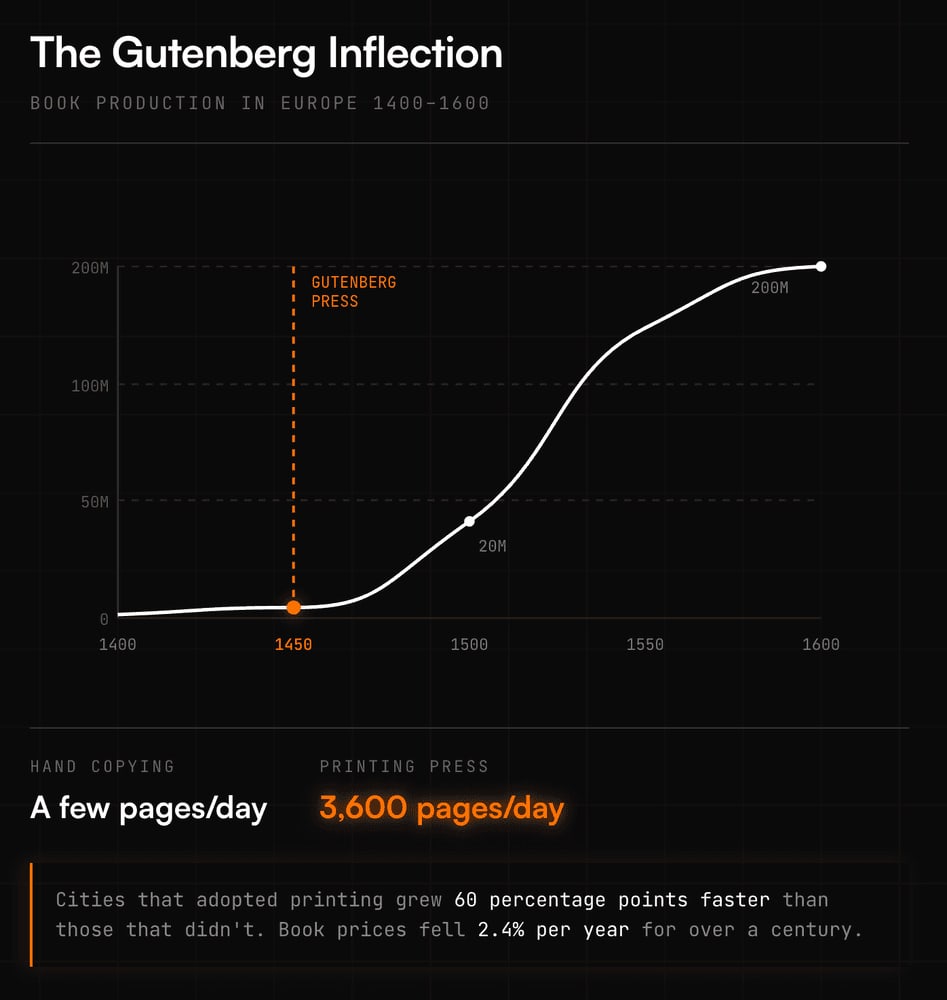
The scribes were trained artisans who had spent years mastering their craft, and they'd just found their skills suddenly worthless. Bookmakers who had employed dozens of them watched their value proposition evaporate.
The printing press didn't make books faster. It made reproduction worthless as a skill. It redefined what was scarce.
Before Gutenberg, the scarce thing was the ability to reproduce text accurately. After Gutenberg, that became trivially cheap. The new scarcities were editorial judgment (what to print), distribution networks (how to reach readers), and reputation (whose content to trust).
The scribes who survived weren't the ones who copied faster. They were the ones who became editors, publishers, and quality assessors. They traded execution for judgment.
In 1850, a shirt took fifteen hours to sew by hand. Singer's machine, patented in 1851, could do it in one.
The displacement at the point of production was brutal. The aforementioned Connecticut shirt factory employed 2,000 hand-sewers making 9,600 shirts per week. After adopting the sewing machine, 400 workers on 400 machines produced 10,000 shirts weekly. Eighty percent of those jobs vanished.
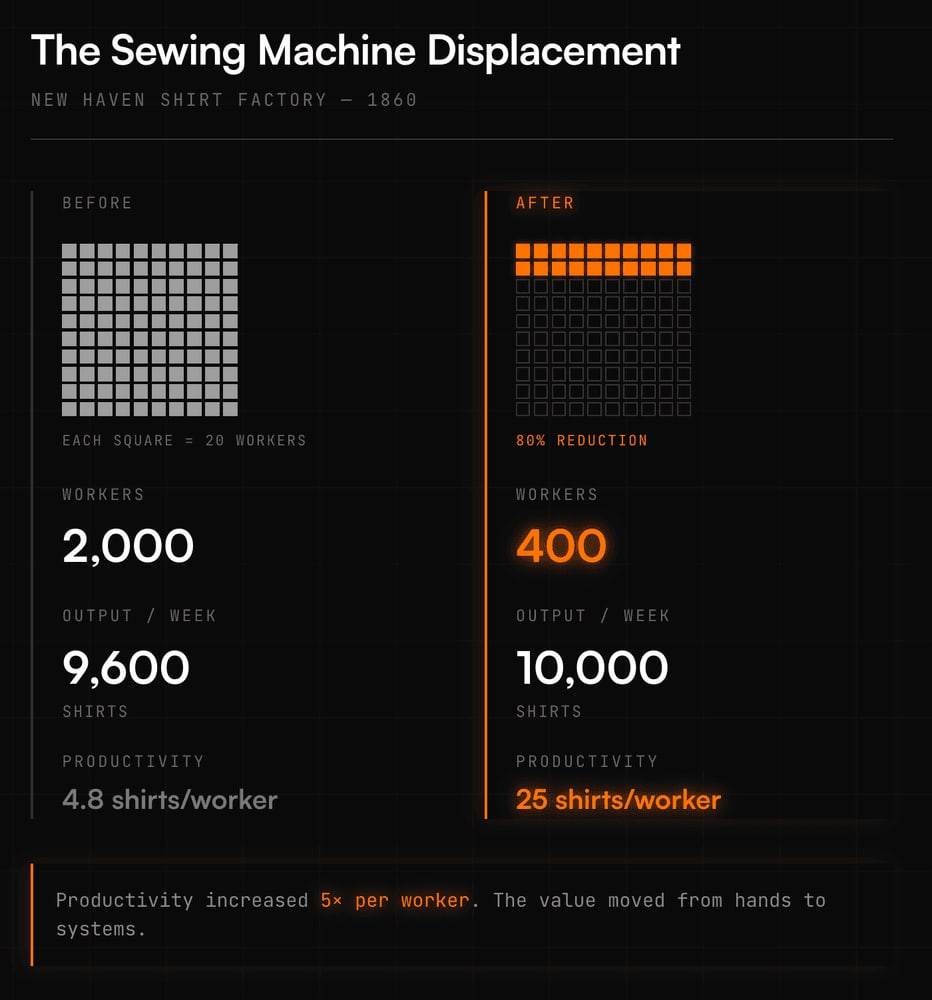
And yet, more people worldwide have been employed in the clothing industry after the sewing machine than before it.
How? Because the machine didn't just speed up production. It made clothing cheap enough that demand exploded. The women's clothing sector grew from $7 million to $32 million in just twenty years. Establishments multiplied from 118 to 562. Employment grew from 5,739 to 25,192. This is what it looks like when efficiency expands total demand.
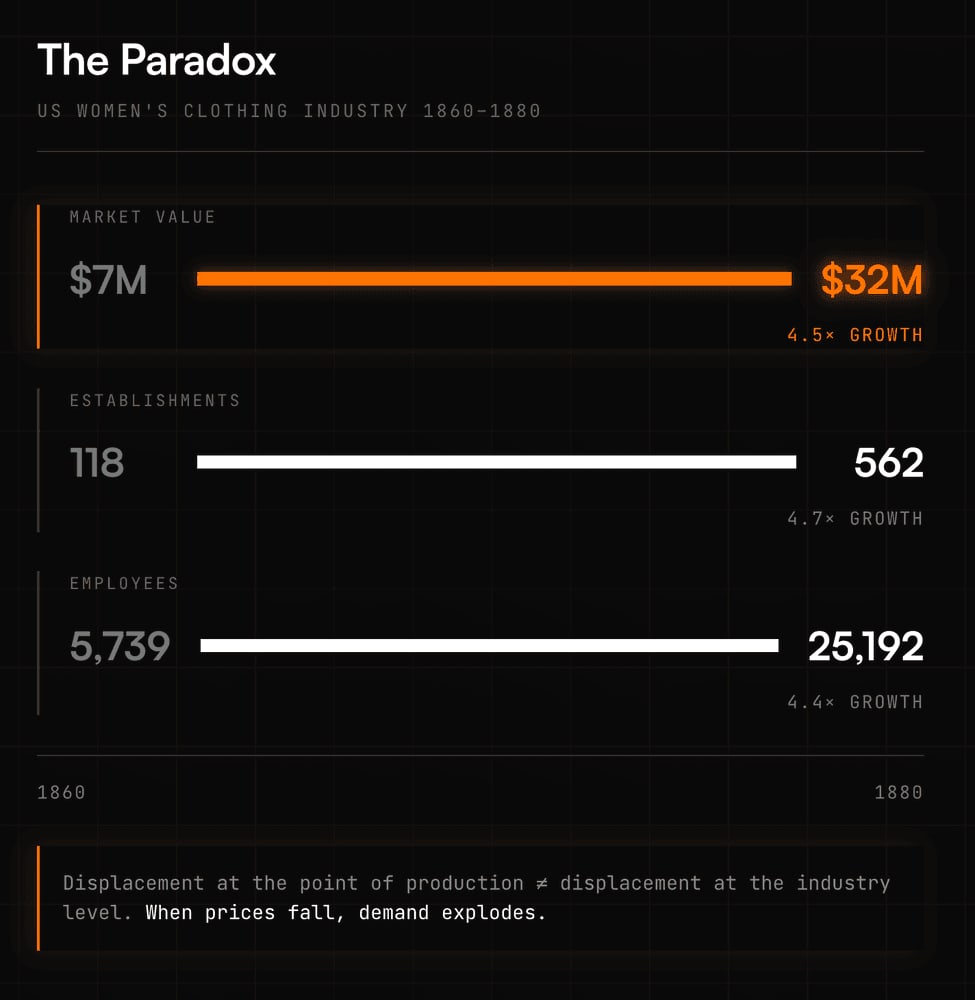
The seamstress who survived wasn't the one who sewed the fastest. She was the one who understood that the new scarcity wasn't stitching, it was design, quality control, and brand reputation. The value moved from hands to systems.
The Death of the Portrait Miniaturist
For 400 years, portrait miniature painters had created tiny, exquisite likenesses on ivory for anyone who could afford them. It was skilled work requiring years of training. By the mid-19th century, it was a thriving profession across Europe and America.
Then came the daguerreotype, the first publicly available photographic process invented by Louis-Jacques-Mandé Daguerre in 1839.
By the early 1850s, Paris studios were producing more than 100,000 photographic portraits per year. New York City alone had over 70 daguerreotype studios, more than all of England combined. The portrait that once required weeks of a painter's time now required minutes.

The miniaturists' markets fell drastically. Many gave up entirely. Others pivoted to hand-colouring photographs and using their craft skills in service of the new technology rather than in competition with it. The 400-year tradition was all but extinguished within decades.
But again, photography didn't eliminate visual artists. It created photojournalism, advertising imagery, motion pictures, and eventually an entirely new conception of fine art. Many painters found that photography offered a much more tranquil career and oft-times ampler fortune than their brushes ever had.
The painters who thrived weren't the ones who could render a likeness most accurately, the camera had won that competition. They were the ones who understood that the new scarcity was artistic vision, emotional resonance, and interpretive judgment. Impressionism emerged not despite photography but partly because of it. When machines could capture reality, artists were freed to capture something else.
Seeing The Pattern?
Every transformative technology follows the same sequence:
First, a productivity explosion. Fifteen times faster. Hundreds of times faster. Infinitely faster. The old way of doing things becomes economically irrational.
Second, a price collapse. Books become affordable. Clothing becomes affordable. Portraits become affordable. What was once a luxury becomes a commodity.
Third, a demand explosion. When prices fall, markets expand. More people want books, clothes, and pictures than could ever have afforded them before. Total employment often increases even as employment in the old mode collapses.
Fourth, and this is the crucial part, a redefinition of scarcity.
The printing press made reproduction trivially easy, so editorial judgment became valuable. The sewing machine made stitching trivially easy, so design and quality control became valuable. Photography made likeness trivially easy, so artistic vision became valuable.
The scarce thing is never the output anymore. It becomes:
Taste and curation: knowing what to make, not how to make it.
Distribution and trust: having the relationships and reputation that make your work findable and credible.
Accountability: being willing to stand behind the outcome when it matters.
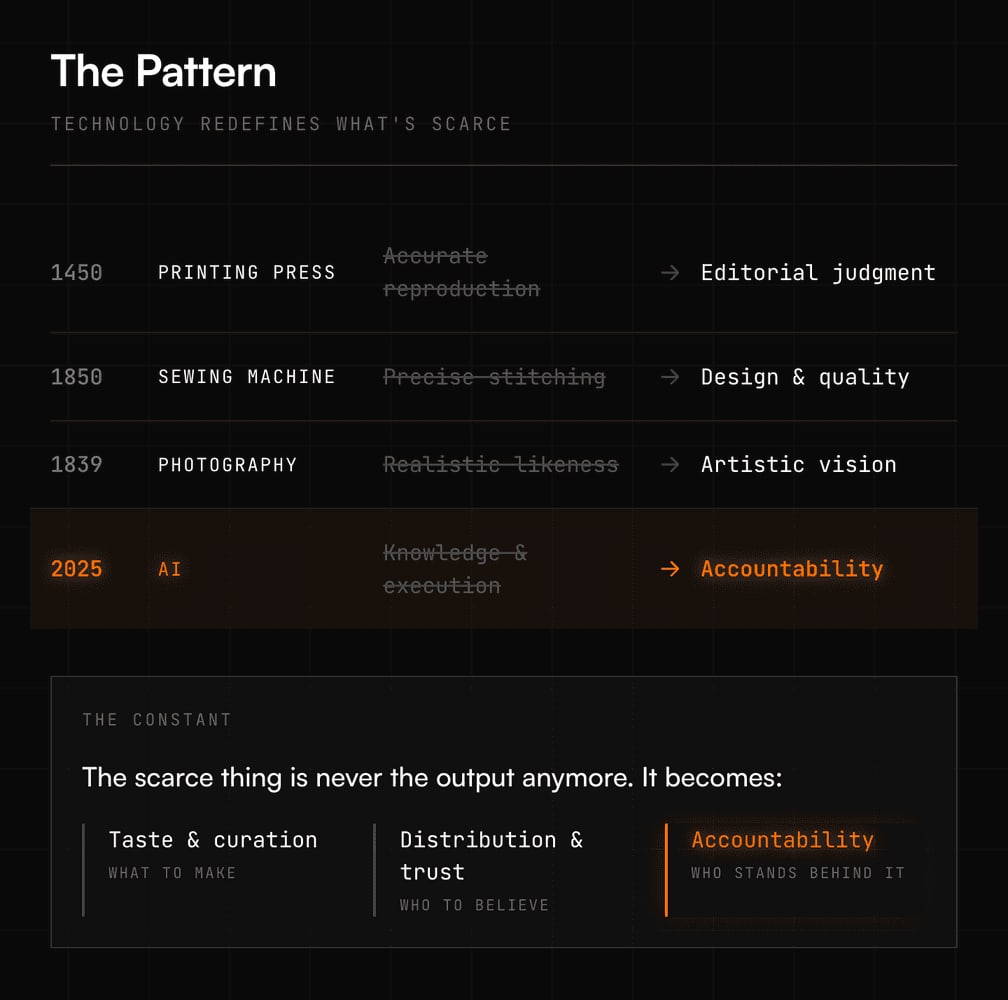
Value moves to what to make, who to believe and who stands behind it.
The Craftsman's Real Value
Here's what each of these transitions revealed: the craftsman's value was never really in their hands.
The scribe's value wasn't in forming letters. It was in knowing which texts were worth copying, catching errors before they propagated, and having the institutional credibility that made their copies trustworthy.
The seamstress's value wasn't in making stitches. It was in understanding fit, judging quality, and building relationships with clients who trusted their recommendations.
The portrait painter's value wasn't in rendering a likeness. It was in capturing character, choosing the telling detail, and creating something that felt true rather than merely accurate.
In each case, the technology stripped away the mechanical layer and exposed what had always been underneath: judgment, taste, and the willingness to be accountable for outcomes.
The People Who Thrived
Look back at each transition. Who succeeded?
Not the scribes who refused to touch a printing press. Not the seamstresses who insisted hand-stitching was superior. Not the painters who dismissed photography as "merely mechanical."
But also not the ones who simply adopted the tools and competed on speed. Faster copying, faster stitching, faster portraits, it's just a race to the bottom.
The ones who thrived were those who understood the new scarcity fastest and repositioned themselves accordingly. The scribes who became editors. The seamstresses who became designers. The painters who became artists in a new sense entirely.
They didn't resist the technology. They didn't just adopt it. They understood what it made scarce and built their value around that.
What This Means Now
The thing is, the technology didn't make any of those people good. It revealed what they already were.
The scribes who became great editors were always editors. They just happened to copy manuscripts for a living. The seamstresses who became designers always had taste. The stitching was how it showed up. The painters who saw differently - photography didn't give them that. It just made the seeing matter more than the rendering.
I'm getting the sense more and more that AI is going to do the same thing to knowledge work. Strip away the execution and see what's underneath.
For some people, there's a lot left. Judgment, taste, the ability to know what's worth doing. For others, the execution was most of it.
Not a comfortable sorting. But probably one that was always true that was just hidden by how hard the mechanical parts used to be.
But I've realised now that history keeps showing us the same pattern: more people worked in clothing after the sewing machine than before. More people worked in publishing after the printing press. Photography created more image-makers than portrait painting ever did.
The jobs don't disappear. They change shape. The mechanical floor falls away, and what's left is the work that actually matters.
We've seen this before. And we're seeing it again but on a much larger scale. The only real question is whether you're paying attention to where the value is moving.